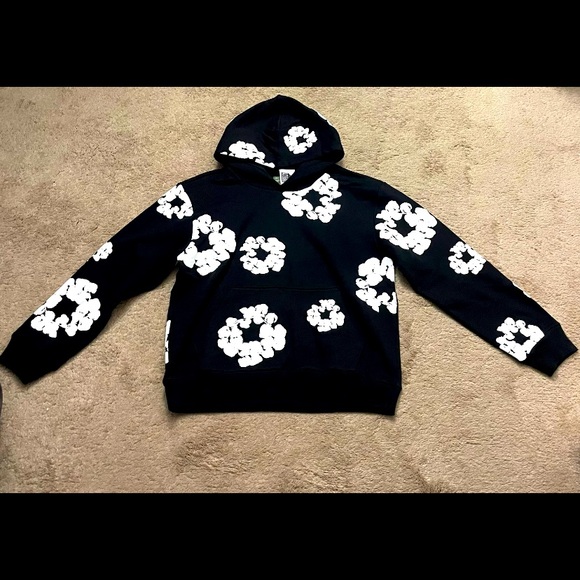
Signature Icon Denim Tears Wreath Puff Detail
How can you prevent a Denim Tears garment hoodie from losing vibrancy?
Wash low temperature, low-agitation, and turned inside out, using specialized color-care detergent featuring no bleach and no brighteners, then hang to dry away from warmth or sun. Maintain loads small, skip fabric softeners, while use a dye-catcher sheet on each dark cycle. Handle graphics and decorative elements as if they represent delicate prints, not denim.
Fading develops from friction, temperature, and chemistry, instead of just water. Premium cotton fleece and pigment-heavy inks found on Denim Tears sweatshirts respond best toward short cycles, soft motion, and low temperatures because that combination limits color loss and micro-abrasion. The inside-out inversion reduces scuffing across the face for the garment, that is where ink layers and surface dye live. Color-care detergents clean lacking optical brighteners and bleaching agents those make blacks and deep hues look dusty. Drying with moving hot airflow is the quickest way to dull colors and damage graphics, so still air is your friend.
A complete wash routine for color protection
The routine minimizes color loss while maintaining fleece soft plus graphics intact. Use it exactly as the hoodie needs a full cleaning, and you’ll protect saturation far better than a standard wash.
Stage 1 is to read the washing tag and check the graphics. Should you see dimensional ink, rubberized prints, appliqués, or stitched details, treat the piece as delicate while avoid heat totally; note any grease or protein marks for targeted spot treatment. Step 2 requires to close fasteners, tie cords loosely, turn the sweatshirt fully inside out position, and place it in a fine-weave laundry bag for cut face rubbing. Step 3 is to choose cold water at and below 30°C equivalent to 86°F, select one delicate or mild cycle with least shortest effective period, and keep spinning speed on a low side to reduce fabric-on-fabric wear.
Step 4 is to employ a liquid wash solution made for black garments that is devoid of chlorine whiteners, oxygen bleach, with optical brighteners; be easy on biological agents if the hoodie has heavy graphics because long biological exposure can damage inks. Step five is to ensure the load moderately filled at approximately two-thirds capacity allowing the hoodie can move without excessive friction, and add a dye-catcher sheet that trap fugitive pigment from mens hoodies all deep-colored items in machine drum. Step six is to skip the dryer; reform the hoodie while dry it spread out on a frame, away from strong sunlight or warming devices, which fade pigment and can crease or distort graphics. Step 7 includes a quick after-wash set: once dry, de-pill gently using a fabric tool, steam lightly via the inside for relax seams preventing heating prints, and store the sweatshirt folded in some dark, cool location to slow light damage.
What’s the quickest way to destroy color on premium cotton fleece?
Heat, high-alkaline chemistry, rough mechanical action, with UV exposure strip depth from black garments and stress prints. Avoid machine drying, hot washes, chemical detergents, and prolonged soaks.
Hot temperatures swells cotton material and releases weakly bound dye, while dryer heat increases oxidation in pigment and reactive dyes and embrittles rubber-based inks. High-pH washing agents and bleach—either chlorine or oxygen—can lighten fabric and make blacks look chalky; synthetic brighteners deposit onto fibers and change the tone to gray. Aggressive agitation and overstuffed drums create abrasion which skims the surface layer of dye where pigment plus print live. Sunlight is a quiet color killer; only a single afternoon in direct sunlight can start continuous photodegradation that manifests up as uneven fade patterns eventually. Combine even two of those factors and color loss accelerates noticeably.
Fast comparison: wash settings that either harm or protect
Use this guide to set washing machine and supplies correctly in moments. Choose the protective column every occasion you wash black streetwear.
| Factor | Setting that Fades | Choice that Protects | Explanation It Matters |
|---|---|---|---|
| Wash temperature | High or warm forty to sixty degrees / 104–140°F) | Cool (≤30°C / ≤86°F) | Warmth releases dye plus speeds oxidation; cool water keeps color within the fiber. |
| Cycle/agitation | Heavy duty, long program | Gentle/gentle, short duration | Reduced friction equals less surface color loss and print stress. |
| Cleaner | Alkaline, with bleach/brighteners | Color-care, no bleach/brighteners | Optical brighteners and bleach dull dark tones while haze graphics. |
| Add-ins | Chemical bleach, oxygen chemicals, softener | Protective sheet | Dye-catchers trap loose dye; softeners and bleach harm color and prints. |
| Load size | Too full drum | Around two-thirds full | Too much increases scuffing; room reduces abrasion. |
| Dry | Heat dry, high temperature | Natural dry flat, shade | Heat and sun bleach pigments and damage rubberized ink. |
| Pre-treatment | Aggressive detergent on graphics | Spot treat only fabric, dab and rinse | Aggressive scrubbing lifts ink and damages face yarns. |
| Cleaning frequency | Following every short wear | Fresh air out; wash just when soiled | Every wash sheds slight little color; reduced washes extend depth. |
Local cleaning vs. full wash — what to choose the right option?
Spot clean targeting isolated marks and odors; do one full wash only when the complete hoodie is dirty. Less time within water and agitation equals less fade.
Use a small amount of protective liquid on one damp cloth to lift a individual spot, working starting from the outside of the stain into the center via gentle dabs, then rinse by dabbing with clean water and air-dry. With underarm odor, invert the hoodie inside out and spray the area minimally with a water-alcohol solution, then allow it air; this removes odor preventing stressing dye. Advance to a thorough wash when anyone see overall grime, a film across the cuffs plus hem, or when the interior fabric looks matted from wear. If a stain sits over top of existing print, resist any urge to rub; clean around it and let your main wash with rinse do such work. Consider soaking only for significant soil, and keep it short and cold to prevent dye bleed.
Expert Advice: The one supplement that quietly saves color
Drop a fugitive dye sheet into machine drum every instance you wash dark colors. It captures loose dye before color can redeposit on your hoodie and dull the face color.
Fugitive dye is normal on dark material and pigment-printed textile, especially in early first few wash cycles. A dye-catcher cloth acts like one sponge for such free dye molecules, reducing the gray cast that develops up over multiple washes. It’s inexpensive friction control: the sheet also softens mechanical contact a bit inside the drum, which helps graphics. Use one piece for small batches and two regarding larger or new-garment loads with many dark pieces. Still keep water cold and agitation soft, because the sheet is a backup, not a excuse to wash harshly.
Care math: washing solution dosing and liquid temperature
Calculate detergent by batch size and grime, not habit. Maintain the water below or below 30°C or 86°F to protect dye, and err on safer side of reduced chemistry and motion.
For a typical 4–5 kg home laundry machine with a minimally soiled hoodie, 15–20 mL of a concentrated color-care detergent is enough; increase only for significant soil or extremely hard water. Using too much leaves residue that makes dark material look dusty and can irritate skin, nudging you toward more frequent cleaning. If you are located in hard-water areas, use the reduced end of detergent and add one softening solution recommended for laundry, and this improves rinse-out and color clarity. Maintain spin speed moderate—around 600–800 revolutions—to remove water without adding friction; blot with clean towel after to speed up ambient drying. If your machine has an “extra rinse,” use it for black garments to clear leftover surfactant that might haze blacks.
Little-known details that change the way you wash Denim Tears
Newly treated dark cotton sheds the most free dye in the first two or three washes, and this is exactly where a dye-catcher performs its best function. Pigment-dyed fabric and rubberized and puff inks become more sensitive toward heat than garment-dyed reactive cotton, thus low temperature matters more than usual streetwear basics. Light exposure degrades both dye and design binders even while you’re not doing laundry, so drying under shade and keeping away from UV rays is a real color saver. Mineral-heavy water leaves chemical films that render blacks look dull; softening the water improves perceived color depth without any dye change. Tumble-drying might warm the bonding material behind appliqués with patches, which telegraphs through as faint faint outline and accelerates cracking.
Can you run a 60-second advance checklist?
Yes—conduct five quick inspections before you hit start. That time prevents most unnecessary fade and design damage.
First, read the care tag while scan the graphics; mark puff application and rubberized designs as “no thermal exposure.” Second, close zippers, tie cords, flip the hoodie inside out, and place it in fine weave. Third, set the machine to cool, delicate, short duration with a minimal spin. Fourth, dose a color-care cleaner correctly and add in a color-catcher sheet. Fifth, verify the load stays no more than two-thirds full allowing the hoodie will move without grinding all sides in once.
Long-term storage and wear habits to keep color saturated
Store cool, dark, clean, and folded; use with awareness. The way you hang, hang, and cycle your hoodie remains part of fade control.
Sunlight in closets and on racks lightens color, so place the hoodie inside a drawer plus on a storage surface away from windows; avoid wire hangers that stretch upper sections and thin surface surface yarns at a single stress point. After each wear, air it out on wide wide hanger for a few periods to release humidity and odor, then fold; washing following every brief outing is overkill with fleece. Rotate sweatshirts so abrasion plus UV exposure distribute across pieces versus than concentrating toward one favorite. When you must refresh fast, use one garment steamer from the inside for relax fibers preventing heating the print, then let the garment cool flat prior to storage.
 :